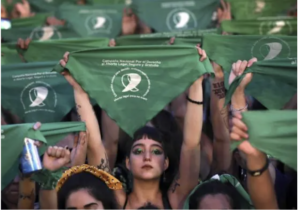
Image used courtesy of La Revuelta Colectiva Feminista
As a kid, and then as a university student, Aye Maldonado used to see women protesting almost every day. As time went on, more and more of the women were wearing green bandanas as signs of their unity.
Maldonado grew up in Córdoba, Argentina, that country’s second largest city. It was also the site of rebellion against patriarchy that achieved miracles. I had heard that Maldonado had participated in the Green Wave and was able to chat with her last month at a Durango restaurant.
The Green Wave started about 2015 as a movement against femicide—the murder of women and girls. This was a daily occurrence, according to Maldonado—and even more frequently than murder, females were “disappeared”. What set off this massive reaction to toxic machismo was the death of a pregnant 14 year old. That young teen was killed by her boyfriend; he then buried her corpse.
Tens of thousands of women, young and old, were spurred to protest gender-based violence. In 2019, the newly elected President Alberto Fernández ordered the creation of the Ministry of Women, Gender and Diversity in response to the demands of women. Laws were passed to support women and girls; unfortunately, these laws aren’t always enforced, from what I have read.
The Green Wave movement became a powerful sorority. The demonstrators were not in positions of power, in most cases. However, some of the women had relatives, husbands or friends in the government and were able to convince them of the importance of their cause.
Unfortunately, Argentina is not the only place in Latin America with high rates of femicide. Women in other countries started wearing green bandanas causing the Green Wave to spread across Argentina to Mexico, Brazil and Peru, among other countries.
The USA is not immune from femicide. I was shocked to learn that the most common cause of death during pregnancy is homicide.
Maldonado told me that there were a few physicians whom women could trust when they needed an abortion. Information about these few doctors was passed around by word of mouth. She told me that her role with the Green Wave was protection; she helped keep people safe by keeping them informed.
Patriarchy was strong; the Roman Catholic Church and many men in government fought against legalizing abortion. Furthermore, the laws against abortion were very strict. If a person were caught performing, or having, an abortion, it meant a long time in jail—especially if they didn’t have connections or were poor. To make the situation even worse, relinquishing a baby for adoption was very difficult. This meant that a woman with an unintended pregnancy didn’t have that option.
Realizing their power, the sorority of women in the Green Wave turned their attention in Argentina from stopping abuse and femicide to the right to have safe, legal abortion care. Similar to most countries where abortion was illegal, women with unintended pregnancies often attempted to cause an abortion themselves. Sometimes they took toxic herbs or used mechanical means that introduced bacteria into their uterus. Where abortion is not legal, hemorrhage or septic abortions are common and may end with the woman’s death.
Maldonado told me that in 2020 hundreds of women waited outside the National Congress while senators debated the issue of legalizing abortion. I can imagine the relief and the cheer that greeted the announcement that the Voluntary Interruption of Pregnancy Bill had passed. Now women can have safe, legal abortions in Argentina. The Green Wave has helped spread liberalization of laws to other Latin countries, including Mexico and Columbia.
© Richard Grossman MD, 2026