Categories
Medical

Create and Enjoy Community

            Many years ago our son Dave wrote a Letter to the Editor of the Herald about the importance of community. As I remember, he praised the new benches in downtown Durango as a way to promote community. I was reminded of that after the events of the last few days.

            My wife and I were headed to a music festival on June 7th. Gail was driving and I was reading the Herald when she said something that grabbed my attention.

            I looked up and saw a white pickup truck headed right for us, in our lane. The next thing I remember clearly was being surrounded by the car’s airbag (which had already deflated, and finding pieces of glass. A couple from Odessa Texas peered through my window and asked if I was ok. I don’t remember exactly what I said—but was happy that there were people there, and that I could respond. I started to feel faint, but was able to recline my seat back and felt better.

            About that time another friendly face appeared at my window. David Austin, a first responder, had been a neighbor at Heartwood and is well known for his sense of humor—but then he was very serious. He asked questions to determine if I was oriented, then swiftly evaluated my physical status. Soon he was replaced by his wife, Sue, who is a nurse in the Centura system. Sue reassured me that I didn’t have a hemopericardium because my neck veins weren’t sticking out. That condition, resulting from chest trauma, can cause faintness, then death if not promptly treated. I was able to walk a few steps and eventually got into an ambulance.

            Gail and I were both taken to Mercy where CT scans showed we both had broken ribs and other minor, but painful, chest trauma. Gail didn’t fare as well as me. She has a fracture of left leg behind the kneecap—the tibial plateau. The “jaws of life” were needed to remove the doors on her side of the car, and there’ll be no walking for her for months.

            We have had amazing support from the many communities in which we are fortunate to participate. A partial list includes the Rotary Club of the Pine River Valley and the Pine River Library (both in Bayfield, Colorado, near where we live). People in the Durango Choral Society with which we both sing, Four Corners OB-GYN and San Juan Basin Public Health where I worked also sent cards or flowers. I’ve had calls and messages from the Friends Meeting (Quakers) to which I belong. Gail has had lots of visitors who have been wonderful to cheer her up.

            We are very fortunate to live in a community that has been supportive, Heartwood Cohousing. Recently I have been able to walk Ty, our dog, but neighbors have helped out at first and when I am not at home. Other neighbors are doing our community jobs for us and are helping to care for our plants and old horse. 

            The medical care has been excellent from the scene of the accident to Mercy where Gail had surgery to place an external scaffolding which immobilizes the affected knee. She was then moved to Cottonwood Rehab where we were greeted by friends and by strangers who soon became friends. She returned to Mercy for the expert surgery on her knee, and then back again to Cottonwood—it was like coming home. They permit Ty to visit (so long as he’s on a leash) and allow me and other guests to join Gail for meals. Gail enjoys the laughter of visiting kids in the in the common areas. The State Patrol Trooper who has been investigating the accident has been wonderful to deal with.

            This has little to do with issues of human population—except for one gratifying letter from someone I don’t know. It affirms the value of these columns. It reads, in part: “I hope you and your wife Gail have quick recoveries from the accident. I have followed your newspaper column for years and [value] your views on women’s rights and world overpopulation. Thank you for your service and educating all of us. Get well soon.” 

          Thank you, Tim W., and the many communities who have supported us.

©Richard Grossman MD, 2019
Categories
Population

Respect “The Population Bomb”

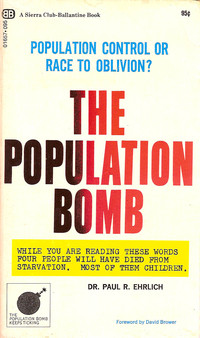
The cover of a book that made a big difference

            A friend sent me a copy of Paul Ehrlich’s classic “The Population Bomb”. I had never read it although it helped to launch concern about human population in the USA. It was different and better than I expected. This little book sold over 2 million copies and introduced many people to the hazards of overpopulation.

            First a little background about Dr. Ehrlich. He is a biologist specializing in butterflies and moths. He has been studying a species of butterfly, a checkerspot, for longer than any other species has been studied by a single person. He has published over a thousand scientific papers and 50 books, which range from “The Birders’ Handbook”, which describes the natural history of all the birds of North America, to “Jaws: The Story of a Hidden Epidemic” about orthodontia, breast feeding and diet). My favorite “Conservation Biology for All” which Ehrlich edited. It is available free, online.

            I had known about Ehrlich’s population activism after “The Population Bomb” was published in 1968. Indeed, I joined ZPG (Zero Population Growth, later renamed “Population Connection”), the organization he helped to found that same year. When I finally read the “Bomb” I was surprised—it wasn’t the diatribe on population that I expected; the book has a much broader view of life on Earth. Much of what is predicted in the book has happened, although not necessarily in the way expected.

            The “Bomb” is much more than a rant about human population. Indeed, it touches upon many concerns that were not commonly discussed 50 years ago, but which now have become major causes of worry. Foremost is climate change. “The Bomb” lists problems that the world was facing in 1968, including “…too much carbon dioxide—all can be traced easily totoo many people.”Does that theme sound familiar?

            Later, Paul Ehrlich was one of the founders of the Society for Conservation Biology, the professional group of scientists working to slow extinction of species. “The Bomb” touches on the importance of nonhuman species, and how our increasing numbers causes increasing extinctions. It uses DDT as an example of toxins in our environment and the lack of governmental control of the millions of available chemicals. Malnutrition and starvation were great concerns in the late 1960s, and “The Bomb” predicted that there would be more hunger as people increased—but also foresaw the possibility of improved agricultural technology that would give some time to slow population growth. Other subjects touched on in this readable book include the value of sex-ed, the importance of avoiding coercion, the promise of using the media to educate about population, and the impact that some religions have in encouraging large families.

            Some people feel that our planet has unlimited resources, and that our greatest resource is people—thus, the more humans, the better. A professor of economics, Julian Simon, was a spokesman for these cornucopians. Simon maintained some absurdities. He stated: “We now have in our hands—really, in our libraries—the technology to feed, clothe, and supply energy to an ever-growing population for the next seven billion years.” Let’s say that the population grew at a slow 1% each year. In seven billion years it would have increased by 3 x 1030249616. This number is a lot larger than a google (10100), and much, much larger than the estimated number of atoms in the universe, which is only 1080! It is difficult to have much faith in someone who would make such an absurd statement.

            â€œThe Bomb” educated readers and catalyzed a huge change in our attitudes about population and family size. I remember reading an article in Life Magazine on ZPG, but never saw any of Dr. Ehrlich’s many appearances on the Johnny Carson show—I was in medical school. The world would be a lot better off now if we had all heeded the book’s message.

            In an article on the 40thanniversary of the publication of The Population Bomb, Anne and Paul Ehrlich wrote of two regrets. Their choice of title was: “Population, Resources, and Environment”, but the publisher chose otherwise. The other concern had to do with authorship. Anne and Paul wrote the book together and consulted many other experts to be certain of the factuality of their statements. The publisher, however, insisted on having just one author. Since Anne has been cited as coauthor of much of the couple’s work, I had wondered whether Paul wrote this bestseller alone. Now I know that it was our chauvinistic society that caused Anne’s name to be left out.

© Richard Grossman MD, 2019