Categories
biodiversity

Meet Three Endangered Animals

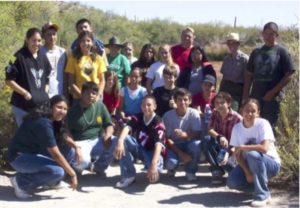
Ajo Middle School Citizen Scientists  NPS photo

I learned about two sea creatures while vacationing this spring near Puerto Peñasco in Mexico. By coincidence, we were close to the home of these two endangered animals, at the north end of the Sea of Cortez.

The totoaba is a large fish that only lives in a very small area, and only spawns in the Colorado River delta. Most notable, however, are its swim bladders, which are prized delicacies in China. These organs make the fish valuable, so that it is often captured even though it is protected by law. Locals fish with gill nets which allow small fish to pass through, but the holes are sized to catch the totoaba.

Totoabas reproduce slowly. They don’t become fertile until they are 6 or 7 years old, but they live to be 15 at most and only spawn just once a year. The young are picky—they require brackish water. Totoaba eggs are laid in the Colorado River delta where the river mixes with the ocean. Indeed, their whole population is confined to the area near the Colorado’s mouth.

Unfortunately, the Colorado River has so much water diverted for human needs that most of the time no fresh water reaches the Sea of Cortez. With no fresh water to mix with the ocean, there is no brackish water for spawning—one of the reasons the totoaba is going extinct.

The second species, the vaquita, is the world’s smallest porpoise and shares in the same small habitat with totoabas. Vaquitas are smaller but plumper than their neighbors causing them to also get caught in gill nets. Since they are mammals, they drown unless they can get to air every few minutes.

These two neighbors are both critically endangered because of habitat destruction and “overharvesting”. Both species are likely to become extinct in the near future. Although the Mexican government has passed laws forbidding the use of gill nets, that hasn’t prevented destruction of the two creatures. Unfortunately the prospect of a large payout from selling a totaba is too large an incentive for many poor fishermen to resist.

Vaquitas are also protected by Mexican law, but they apparently are only killed by accident. Their population, which was never large, is now estimated to be as few as a dozen. These animals are secretive and difficult to see, but scientists can listen to their high frequency sound, which vaquitas use to communicate. These calls allow scientists to estimate the animals’ numbers.

In an effort to save vaquitas, scientists from 9 countries banded together to organize VaquitaCPR. After months of planning they captured one of these little animals, with the hope of keeping it safe in an enclosed area of ocean. The specimen showed signs of severe stress, however, so they released her. The second animal didn’t fare as well—it died shortly after capture. 

I first read about vaquitas and totoabas in a Scientific American article, “Goodbye, Vaquita: How Corruption and Poverty Doom Endangered Species”. It is sad to learn that our human needs and carelessness are destroying these beautiful animals.

Driving home from Puerto Peñasco we entered Organ Pipe Cactus National Monument right after we crossed the border. We stopped at the visitor center to get oriented to the Monument and eat a picnic lunch. The nature trail offered a great way for all 3 of us (our dog traveled with us) to stretch our legs. At its end we were surprised to find a small oasis with shady trees, luxuriant plants, a pond and a sign with the unpronouncable title: “Quitobaquito Pupfish”. This is the name of another endemic species—meaning its entire geographic range is tiny, like the totaba and vacquito. This species of pupfish only occurs naturally in 2 places in the world. In the USA the only habitat is in the Monument’s Quitobaquito Spring, which forms a small pool. The second location in the Rio Sonoyta, just over the border in Mexico.

A few years ago the Spring appeared to be drying up. In an attempt to preserve these small, rare fish, the Monument enlisted the help of 160 young citizen scientists—students at the nearby Ajo middle school! They collaborated to design and to build the pupfish refuge. The kids continue to monitor the condition of the oasis, water quality and number of fish.

This story of endangered species started out sadly with the totaba and vaquito, but has a happy ending with the pupfish. Unfortunately, many more species are lost to our expanding human population than can be saved.

© Richard Grossman MD, 2018

Categories
Action children

End Gun Violence

“…I call on President Trump and the Republican controlled House and Senate and Executive Branch to work together, get some bills passed and stop taking money from the NRA because children are dying and so is the future of America as a result.”

David Hogg, survivor of the school shooting in Parkland, Florida last month

“To every politician who is taking donations from the NRA, shame on you.”

Emma Gonzalez, another survivor, who has more Twitter followers than the NRA

I morned the 17 people who were killed in the mass school shooting in Florida. Then I realized that I have a granddaughter who is in high school, and that her life might be in danger; this made me feel afraid and angry. Why should a 14 year old have to worry about getting shot at her school?

Every year there are more than 37,000 gun deaths in the USA, including about 22,000 suicides. 2017 was the worst so far, with 15,591 homicides. Incredibly, there were 732 children and 3234 teens who were injured or killed by guns. These are data from the Gun Violence Archives. You probably know already that the USA has many times the gun violence of any other developed country.

Why? Although mental illness is blamed frequently, it should noted that 98% of people pulling the trigger are men. Women also have mental illness, but they are much less responsible for shootings. Male aggression (!) and the easy availability of guns are contributing factors to most shootings.

Unfortunately, our government has not taken responsibility for the ease with which guns can be purchased. Indeed, in 1996 an amendment to the omnibus spending bill stated: ”…none of the funds made available for injury prevention and control at the Centers for Disease Control and Prevention may be used to advocate or promote gun control….” This has effectively halted research into gun deaths.

How did this happen? Certainly the deaths of thousands of Americans is a public health crisis! The National Rifle Association wields immense power in Washington; it was they that effectively put a stop to gun injury research. The NRA has bought our senators and representatives. All told, the NRA has given Colorado Senator Cory Gardner $3,879,064, according to the New York Times. Gardner’s comment after the Las Vegas shooting was: “My family and I are praying for the families of those injured and killed….” He has not taken any substantive action to stop the shootings. The Washington Post wrote that Representative Scott Tipton has received $19,950 from the NRA.

Shootings are a terrible way to reduce our population! In my series of bad ways to decrease human numbers, this is one of the worst, since shooting victims are often young people. What can we do to reduce the slaughter? I offer several ideas.

Do you remember Gabby Giffords, the Arizona representative who was shot in the head while campaigning? Sign her pledge at: https://action.giffords.org/page/s/gabby_giffords_pledge. It says, in part, “…I will use every means available to make sure we have a different Congress, one that puts communities’ interests ahead of the gun lobby’s.”

Another idea is to require gun owners to purchase insurance, just as car owners do. Then if you, or a gun you own, shoots someone, the insurance would help with bills. The effect would be strong because insurance companies would pressure gun stores to keep guns out of the hands of the wrong people, and limit assault weapons.

Already PayPal, Square, Stripe and Apple Pay don’t allow their services to be used for the purchase of guns. Andrew Ross Sorkin suggests that all financial institutions—including banks and credit card companies—should stop doing business with retailers that sell assault weapons, high-capacity magazines and bump stocks. This would not be a cure, but it would be a step in the right direction for the sickness of shootings.

Nicholas Kristof has an excellent online essay “How to Reduce Shootings”. It is a clear statement of the problem, and includes 9 ways to approach a solution. One of them is to research “smart guns” which require a PIN or fingerprint before they can be fired.

I am pleased that teens such as David Hogg and Emma Gonzalez, both quoted above, are stepping up to be gun safety activists. Please join me on March 24th at a local March for Our Lives. Starting at 1PM we will meet at the Durango High School parking lot and march to Rotary Park.

© Richard Grossman MD, 2018