Categories
Reproductive Health

Two Reproductive Health Heroines

A woman came to me with a very sad and perplexing story shortly after I started practicing OB-GYN. She was in her late 30s and had 2 or 3 children. She told me that she had been raped at work in a janitorial closet, after all the other staff had left. She did not report the assault—in the mid 1970s there was no provision for the care of sexual assault survivors in our town.

This woman went to her family doctor, she told me, because her period was late. He told her that she shouldn’t worry—that she was still recovering from the trauma of what had happened to her. A month later she still hadn’t started her period and she returned to that doctor and requested a pregnancy test. He told her not to worry, and didn’t order the test. The third time he did what she wanted, and the test was positive. If I were she, I would be terrified of her coworker and outraged at the doctor.

There are three lessons here: Even good doctors are fallible. Pregnancy is common after rape, even though there is a false belief that it is rare. Do-it-yourself pregnancy tests are a good idea.

When I was in medical school the only pregnancy test involved injecting an animal with a sample of the woman’s urine—and waiting a couple of days for the result.

Tests had improved a few years later when I was in general practice. We had kits that the nurse would use. As I remember, it took a half hour for the test to develop, so we’d often call the patient when the result was available. Unfortunately, a positive result looked different with different brands of tests. When we switched brands we misinterpreted a few tests and made some embarrassed calls. “I’m sorry to say that what I told you yesterday was wrong. Your test result is negative, not positive.”

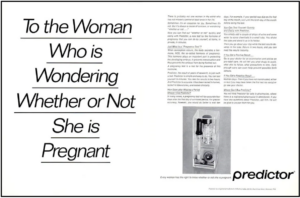
Now you can get tests at the store that are inexpensive, sensitive and quite accurate. We can thank Margaret Crane, a product designer at Organon who designed the first at-home test. It became available in 1971 in Canada, but not until 1977 in the USA.

What caused the lag in making it available in this country?  The (male) executives of her company didn’t trust women to do their own tests. There might also have been some pressure from the medical community to not give up the income from pregnancy testing. This innovation required a woman with imagination, artistic ability and faith in womenkind to make the first model of a home pregnancy test.

Another heroine of reproductive health just died. Sharon Camp earned a doctorate in foreign relations, then spent years in D.C. as a lobbyist. She learned that Emergency Contraceptive Pills (ECPs) were available in Europe, but not in the USA. This seemed wrong to her, and she lobbied drug manufacturers to sell ECPs, but without success. Although she had no background in the pharmaceutical business, she started her own company to market Plan B, the first ECP in the USA.

At first the FDA required a prescription for Plan B. I told the local pharmacies that I was available to call in that prescription, and did so many times for women whom I never met. Later Camp lobbied the FDA successfully to make ECPs available without a prescription to women over a certain age, and eventually to women without any age limit. 

Neither Crane nor Camp had medical training. However, both realized a need and were able to find a way to help women get the care they wanted. They found ways to lower barriers to reproductive health care.

©Richard Grossman MD, 2025
Categories
Population

Follow the Progress of IUDs

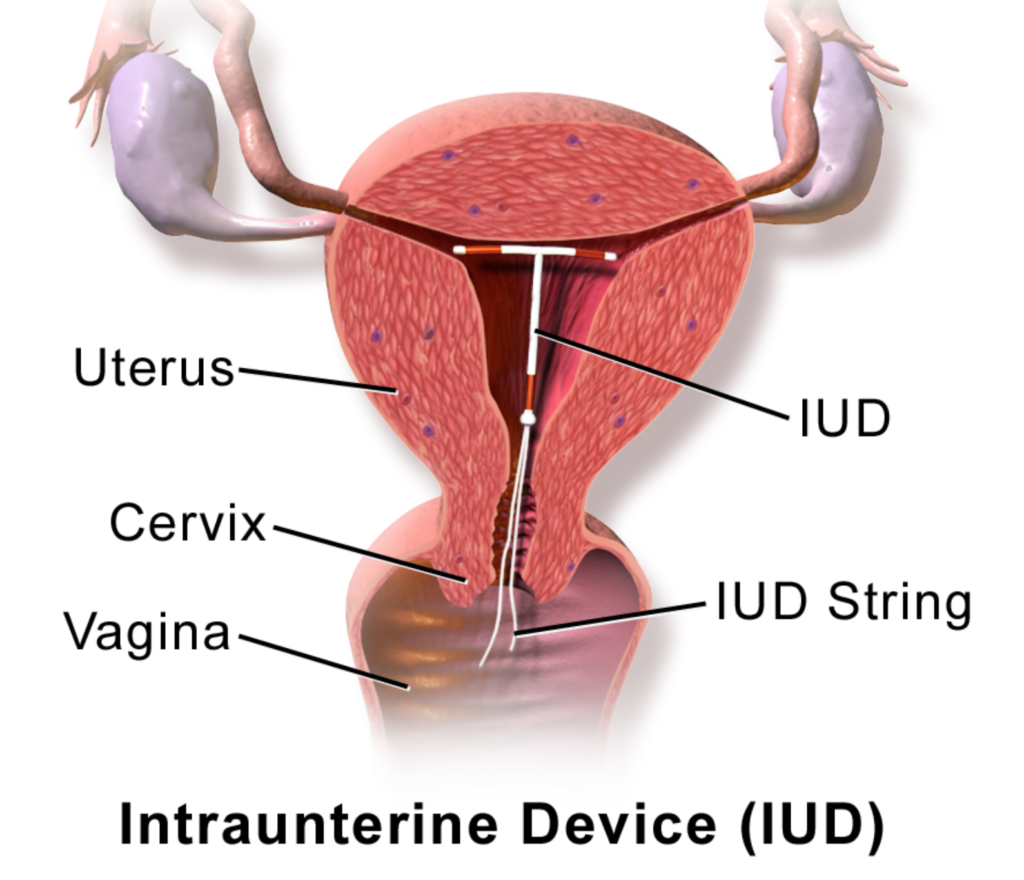
Image from Medical Gallery of Blausen

            After our first son was born my wife, Gail, wore a Lippes loop IUD for 3 years. It worked well; our second son was born about 9 months after its removal.

            In the 1950s IUDs were controversial. Fortunately, one doctor had the gumption to develop the first widely-used model. Dr. Jack Lippes was a professor of OB-GYN at the University of Buffalo when he invented the Lippes loop in the 1960s. Loops were used from 1965 until 1986 with a remarkable record of safety and effectiveness. Lippes himself is still actively working on family planning technology at age 94!

            Current IntraUterine Devices are small, T-shaped pieces of flexible plastic with a monofilament string for removal attached to the long arm. All IUDs in the USA now are better than 99% effective due to something added to the plastic. Four are enhanced with a hormone and one uses copper.

            There are several thoughts about how IUDs work; it seems as though most of the action is on sperm. Levonorgestrel, the hormone, makes cervical mucus tacky so sperm cannot swim into the uterus. Hormonal IUDs usually make periods less unpleasant for women who have heavy bleeding or bad cramps. 

            The copper in the Paragard® is toxic to sperm, and it also makes the lining of the uterus less hospitable. Some women want to know if IUDs work by causing an abortion. To me, that is more of a philosophical question than a medical one. It depends on when you consider life starts, as well as other factors that are more philosophical than medical. However, my feeling is that if one were to define the action of an IUD as being an abortifacient, it is so only rarely and very early in pregnancy.

            The best way to lower the abortion rate is with good contraception. The teen abortion rate dropped by 60% and the number of teen births by almost that much when free IUDs, and all birth control, were made available in Colorado. Yes, it is safe for teens to us IUDs!

            How long are IUDs effective? Again, that gets into the realm of philosophy. For two IUDs the Food and Drug Administration says one thing and good research says another. The FDA states that the Paragard® is effective for 10 years, but studies have shown that it is very effective for up to 12 years. Therefore, Planned Parenthood recommends that a Paragard® can be used for a dozen years so long as it is not causing problems and the woman still wants contraception. Extending the duration is an “off-label” use.

            Another off-label use of the Paragard® is for emergency contraception. In case of rape, condom failure or poor planning, a Paragard is the most effective means of preventing pregnancy if inserted within 5 days of unprotected intercourse. The insertion can be the beginning of 10 (or 12) years of highly effective contraception.

            IUDs went through a bad era in the early 1970s. Women suffered because the Dalkon Shield IUD was brought to the market without sufficient testing. Some women wearing Shields had unplanned pregnancies. Some of these pregnancies became infected causing at least 4 maternal deaths. Some women even required a hysterectomy for a severe pelvic infection due to the Shield. Many other women had infections caused by Shields that made them infertile. Even though Shields were taken off the market in 1974, IUDs’ reputation suffered. 

            The effectiveness, safety and other advantages of current IUDs have led to high acceptance. The chief disadvantage of this means of birth control is expense. Fortunately, Obama Care and most insurance will pay for the woman’s choice of contraception, but cost can be a deterrent for uninsured women. Studies, including one here in Colorado, have shown that many women will choose an IUD (one type of Long Acting Reversable Contraception) if price is not an issue. This is reflected by the percentage of American contracepting women using IUDs–about 12% now, up from 1% in 1970.

            In a recent symposium on IUDs, two issues received the most attention. One was how women can safely get IUDs during the pandemic. Telemedicine for counseling is a solution to decrease risk.

 The other issue was IUD removal. Remember the string mentioned above? Usually removal is a simple procedure for a practitioner to grasp the string and pull out the IUD. However, one study found that the average charge for this is more than $250 and some providers charged over $1000! Women can remove their own IUDs, as two of my patients demonstrated. One told me she laid down and used her fingers to find the strings and tugged. The other succeeded in getting her IUD out, but with bad consequences. She removed her device in the shower, fainted and fell through the glass door! I don’t recommend that technique.

© Richard Grossman MD, 2019