Categories
Reproductive Health

Two Reproductive Health Heroines

A woman came to me with a very sad and perplexing story shortly after I started practicing OB-GYN. She was in her late 30s and had 2 or 3 children. She told me that she had been raped at work in a janitorial closet, after all the other staff had left. She did not report the assault—in the mid 1970s there was no provision for the care of sexual assault survivors in our town.

This woman went to her family doctor, she told me, because her period was late. He told her that she shouldn’t worry—that she was still recovering from the trauma of what had happened to her. A month later she still hadn’t started her period and she returned to that doctor and requested a pregnancy test. He told her not to worry, and didn’t order the test. The third time he did what she wanted, and the test was positive. If I were she, I would be terrified of her coworker and outraged at the doctor.

There are three lessons here: Even good doctors are fallible. Pregnancy is common after rape, even though there is a false belief that it is rare. Do-it-yourself pregnancy tests are a good idea.

When I was in medical school the only pregnancy test involved injecting an animal with a sample of the woman’s urine—and waiting a couple of days for the result.

Tests had improved a few years later when I was in general practice. We had kits that the nurse would use. As I remember, it took a half hour for the test to develop, so we’d often call the patient when the result was available. Unfortunately, a positive result looked different with different brands of tests. When we switched brands we misinterpreted a few tests and made some embarrassed calls. “I’m sorry to say that what I told you yesterday was wrong. Your test result is negative, not positive.”

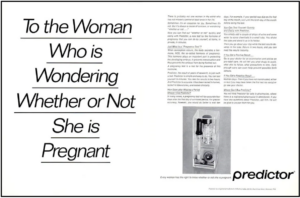
Now you can get tests at the store that are inexpensive, sensitive and quite accurate. We can thank Margaret Crane, a product designer at Organon who designed the first at-home test. It became available in 1971 in Canada, but not until 1977 in the USA.

What caused the lag in making it available in this country?  The (male) executives of her company didn’t trust women to do their own tests. There might also have been some pressure from the medical community to not give up the income from pregnancy testing. This innovation required a woman with imagination, artistic ability and faith in womenkind to make the first model of a home pregnancy test.

Another heroine of reproductive health just died. Sharon Camp earned a doctorate in foreign relations, then spent years in D.C. as a lobbyist. She learned that Emergency Contraceptive Pills (ECPs) were available in Europe, but not in the USA. This seemed wrong to her, and she lobbied drug manufacturers to sell ECPs, but without success. Although she had no background in the pharmaceutical business, she started her own company to market Plan B, the first ECP in the USA.

At first the FDA required a prescription for Plan B. I told the local pharmacies that I was available to call in that prescription, and did so many times for women whom I never met. Later Camp lobbied the FDA successfully to make ECPs available without a prescription to women over a certain age, and eventually to women without any age limit. 

Neither Crane nor Camp had medical training. However, both realized a need and were able to find a way to help women get the care they wanted. They found ways to lower barriers to reproductive health care.

©Richard Grossman MD, 2025
Categories
Contraception Hope Reproductive Health

FP2020

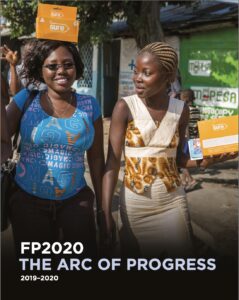
  Why are these women smiling?

            What if every woman in the world had access to her choice of safe, effective contraception? So far, this is a dream, but two programs are helping this dream come true.

            In the past, only members of the rich elite had access to family planning (at least among English-speakers). Francis Place in England (1823) and Margaret Sanger in the USA (1916) brought Family planning to disadvantaged people. Sanger is accused of having racist or classist motivation, but Place, a revolutionary thinker, was a commoner. He learned how the rich controlled their fertility and spread that knowledge through a series of pamphlets. Both of these pioneers realized that limiting a couple’s fertility would be likely to improve their well-being.

            The London Summit on Family Planning in 2012 was organized to continue Place’s work, on an international scale. People gathered in London from 120 countries and included doctors, social scientists and financial donors who came up with an international program, Family Planning 2020 (FP2020). In those few years between 2012 and 2020 they hoped to provide 120 million women (and men) with contraceptive information and supplies.

            One of UN2020’s initial concerns was that it not coerce people to use contraception, as happened in China and India. Social scientists drew up rules to try to avoid any semblance of coercion—all motivation had to be strictly voluntary. Thus, there would be no undue incentives nor any quotas. These steps would help ensure that all adaptors of contraception did so without pressure. In the organization’s own words, it “…is a global movement that supports the rights of women and girls to decide—freely and for themselves—whether, when, and how many children they want to have.” It is amazing that FP2020 functioned in some very patriarchal societies in Asia and Africa.

            The governments of more than 30 of the world’s richer countries pledged money to support FP2020. Major funding included the US Agency for International Development, the Gates Foundation and the United Nations Population Fund. Although FP2020 worked in some of the least wealthy countries in the world, each of the 69 countries where they provided care also had to provide some funding.

            The Covid 19 pandemic started just as FP2020 was ending. Despite the risk of spreading the virus, the program found ways to deliver high quality reproductive health care. The program was able to continue its outreach using strict precautions.

            How successful was FP2020? The program fell short of its ambitions goal. The final tally is that it increased the number of modern contraception users by 46 million. Nevertheless, this is a pretty amazing feat! An impressive way of measuring the program’s success is that it doubled the number of users in 13 African countries. The use of modern contraception in these poor countries is estimated to have prevented millions of unsafe abortions and over a hundred thousand maternal deaths. What intervention could be more humane?

            Because populations were growing rapidly where FP2020 worked, the need for family planning increased faster than FP2020 could reach potential users. It is estimated that the number of women of reproductive age grew by 15 million each year! That is the challenge for the program that succeeded FP2020, unsurprisingly labeled “FP2030”. The successor has more local direction and less management from donor countries, and has expanded to 82 countries. Funding is its biggest problem, unfortunately, especially since some funders have reneged on promised donations. FP2030 is directing its focus on adolescent pregnancy. If a woman is empowered by modern family planning when she is young, it is likely that she’ll be a lifelong user.

There is a success story here. The teen pregnancy rate is already dropping globally, thanks to programs such as FP2020 and FP2030.

© Richard Grossman MD, 2024