Categories
Abortion Action Contraception Politics

Bills to Support in Congress

One of my former partners rephrased the Bible, saying: “what the lord giveth, the lord can take away.” I fear that he might be correct.

Supreme Court Justice Thomas concurred with the majority in the Dobbs 2022 decision, taking away the right to abortion care in all states. It is frightening that he stated, in that decision, that the Court should reconsider “Griswold”. “Griswold” was the 1965 decision which made contraception legal nationwide. Unfortunately, Thomas is not alone. There has been an undercurrent of right-wing people and politicians who feel that birth control should be outlawed. Perhaps they come from the religious viewpoint that “every sperm is sacred”, to quote Monty Python. Or perhaps they want more poor people to do the world’s scutwork so the rich can sit back and enjoy life.

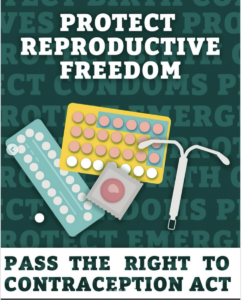
A bill in Congress intends to insure our right to contraception. Called the “Right to Contraception Act”, its short description states that the bill’s purpose is: “To protect a person’s ability to access contraceptives and to engage in contraception, and to protect a health care provider’s ability to provide contraceptives, contraception, and information related to contraception.”

This bill passed in the House in 2022. Unfortunately, it was blocked in the Senate two years later. Some Democratic senators are still trying to pass it. Senator John Hickenlooper wrote me: “…I am a cosponsor of the Right to Contraception Act and voted to advance the bill when it came to the Senate floor on June 5th [2025]”.

Legislators in at least four states have tried to limit access to contraception by various means. Some states have restricted public funding. Indiana law prohibits placing an IUD after a woman gives birth because of the misapprehension that IUDs cause abortions. In addition, some states have included some contraceptives, including emergency contraception, in their restrictive abortion laws. I wish that it were as easy to poke holes in these lawmakers’ condoms as it is to poke holes in their reasoning!

Colorado has legal support for our right to birth control, as do some other states. Ours is called “The Reproductive Health Equity Act” and is part of the 2022 law guaranteeing access to abortion care.

There is another glimmer of hope in Washington. Both houses of Congress have bills to stop the Global Gag Rule (GGR). This rule of law prevents any recipient of federal funding to discuss abortion. When women can’t find out about legal abortion services, often they seek unsafe abortions. Thus, the GGR is responsible for the deaths of thousands of desperate people.

The Global Health, Empowerment and Rights (Global HER) Act would reverse the GGR and prevent any similar act in the future. It would allow healthcare workers the freedom of speech to tell patients how to access safe abortion services. It would save lives of mothers and teenagers. 

According to the World Health Organization (in which the USA no longer participates): “Reproductive rights rest on the recognition of the basic right of all couples and individuals to decide freely and responsibly the number, spacing and timing of their children and to have the information and means to do so, and the right to attain the highest standard of sexual and reproductive health….”

Please contact your senators and ask them to support the Right to Contraception Act (S.4381). I suspect that all US senators have used contraception at some time in their lives; all Americans should have that right! Also, ask your senators and representatives to support the Global HER Act; that’s S.280 in the Senate and H.R.764 in the House.

©Richard Grossman MD, 2026

Categories
Action Public Health

We Lost a Superb Activist for Women’s Health

I attended an international family planning meeting in Santo Domingo, the Dominican Republic, in 1984. At that time we were living just a short plane ride away in Puerto Rico.

The meeting was full of people from different countries speaking different languages and was an excellent opportunity to make connections in the family planning world. One person was outstanding.

I was chatting with someone one afternoon and mentioned that I was tired and was headed back to our hotel to take a nap. “You should stay and listen to the next speaker, Malcolm Potts. He is amazing, mixing a lot of knowledge with a bunch of British humor”.

I took their advice, and was not disappointed. Dr. Potts was a world leader in family planning. He died this spring at age 90.

Potts was an innovator. He helped to start the first clinic in Cambridge, England, that offered birth control to young people. He was also the first director of the International Planned Parenthood Federation. He collaborated with Dr. Karman, a psychologist, to develop a simple technique for treating miscarriages and performing early abortions. It uses a flexible cannula with vacuum created by a syringe, thus it is especially useful in places where there is no electricity. Although I learned the Karman method long ago, only by reading it in an obituary of Malcolm’s did I realize that he had aided in its invention.

Potts told me how he had helped with another innovation. The work of Henry David, a psychologist, is often quoted to help justify abortion. David studied children born to women twice denied abortion for the same pregnancy. He followed these kids for 20 or more years. The studies unequivocally showed that the children of unwanted pregnancies did not do as well as matched controls. Potts told me that it was he who suggested David study unintended pregnancies in Prague, Czech Republic, because they had stringent laws limiting who could have an abortion at that time.

In 1984 I interviewed for a job where Potts was the director. It had been called the “International Fertility Research Program”. Potts had realized that the name was long and might prejudice some people against the organization, so had it changed to the more copacetic “Family Health International”.

More recently Potts was the inaugural director of the Bixby Center for Population, Health, and Sustainability, and held an endowed chair at the Berkeley School of Public Health. He was an admired professor and used his imagination to innovate: his nonprofit, OASIS, advances education and choice for women and girls in the African Sahel. He also cofounded a company that is trying to bring birth control pills to the marketplace without the need for a prescription.

My favorite saying of Potts dates from the era when tobacco was sold in vending machines: “Birth control pills should be available in vending machines and cigarets only by prescription.” His wish has come partly true—now cigaret sales are much more restricted and reproductive health materials are available in vending machines. Many college campuses have machines that dispense condoms, pregnancy tests, emergency contraceptive pills and now, even Opill, the new over-the-counter birth control pill without estrogen (see photo above).

Potts was a pioneer in lowering barriers to reproductive health care. For instance, he set up a clinic at a central train station in India to perform vasectomies because people feared hospitals. He was known for this sort of imaginative, out-of-the-box thinking.

One of his coworkers, Alisha Graves, stated that Potts believed “We really have to trust that women are doing the best things for themselves and their families.” It took me years to come to the same conclusion.

© Richard Grossman MD, 2025