Categories
Abortion Action Contraception Politics

Bills to Support in Congress

One of my former partners rephrased the Bible, saying: “what the lord giveth, the lord can take away.” I fear that he might be correct.

Supreme Court Justice Thomas concurred with the majority in the Dobbs 2022 decision, taking away the right to abortion care in all states. It is frightening that he stated, in that decision, that the Court should reconsider “Griswold”. “Griswold” was the 1965 decision which made contraception legal nationwide. Unfortunately, Thomas is not alone. There has been an undercurrent of right-wing people and politicians who feel that birth control should be outlawed. Perhaps they come from the religious viewpoint that “every sperm is sacred”, to quote Monty Python. Or perhaps they want more poor people to do the world’s scutwork so the rich can sit back and enjoy life.

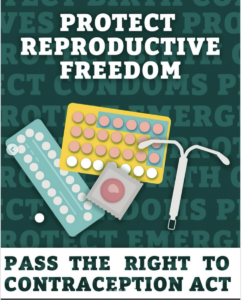
A bill in Congress intends to insure our right to contraception. Called the “Right to Contraception Act”, its short description states that the bill’s purpose is: “To protect a person’s ability to access contraceptives and to engage in contraception, and to protect a health care provider’s ability to provide contraceptives, contraception, and information related to contraception.”

This bill passed in the House in 2022. Unfortunately, it was blocked in the Senate two years later. Some Democratic senators are still trying to pass it. Senator John Hickenlooper wrote me: “…I am a cosponsor of the Right to Contraception Act and voted to advance the bill when it came to the Senate floor on June 5th [2025]”.

Legislators in at least four states have tried to limit access to contraception by various means. Some states have restricted public funding. Indiana law prohibits placing an IUD after a woman gives birth because of the misapprehension that IUDs cause abortions. In addition, some states have included some contraceptives, including emergency contraception, in their restrictive abortion laws. I wish that it were as easy to poke holes in these lawmakers’ condoms as it is to poke holes in their reasoning!

Colorado has legal support for our right to birth control, as do some other states. Ours is called “The Reproductive Health Equity Act” and is part of the 2022 law guaranteeing access to abortion care.

There is another glimmer of hope in Washington. Both houses of Congress have bills to stop the Global Gag Rule (GGR). This rule of law prevents any recipient of federal funding to discuss abortion. When women can’t find out about legal abortion services, often they seek unsafe abortions. Thus, the GGR is responsible for the deaths of thousands of desperate people.

The Global Health, Empowerment and Rights (Global HER) Act would reverse the GGR and prevent any similar act in the future. It would allow healthcare workers the freedom of speech to tell patients how to access safe abortion services. It would save lives of mothers and teenagers. 

According to the World Health Organization (in which the USA no longer participates): “Reproductive rights rest on the recognition of the basic right of all couples and individuals to decide freely and responsibly the number, spacing and timing of their children and to have the information and means to do so, and the right to attain the highest standard of sexual and reproductive health….”

Please contact your senators and ask them to support the Right to Contraception Act (S.4381). I suspect that all US senators have used contraception at some time in their lives; all Americans should have that right! Also, ask your senators and representatives to support the Global HER Act; that’s S.280 in the Senate and H.R.764 in the House.

©Richard Grossman MD, 2026
Categories
Abortion Contraception Politics

News–Good and Bad

The really bad news is that we have elected a misogynistic felon with a narcissistic personality disorder. Even worse news is that people have fallen for Trump’s lies.

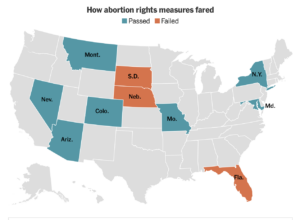
          There’s some good news, despite lots of disappointments. In my state, Colorado, almost 2/3rds of voters chose to amend our constitution to guarantee the right to safe abortion care. In addition, the state will start paying for abortions for women who are state and local government employees, and for those on Medicaid.

            The state to our north, Wyoming, had abortion laws preventing almost all abortions. In November, a Wyoming judge ruled that the laws were against that state’s constitution. She wrote: “The abortion statutes suspend a woman’s right to make her own health care decisions during the entire term of a pregnancy and are not reasonable or necessary to protect the health and general welfare of the people.” Although the state will probably appeal this decision, for now women can obtain safe, legal abortion care in Wyoming.

            Public health scientists have identified several causes why young children don’t flourish. Children may not do well if pregnancies are too close together. We also know that if a mother really, really doesn’t want to carry a pregnancy, but is forced to give birth, that the child may not fare well. Do children who result from unintended pregnancies also suffer?

            “Yes” is the sad answer. Researchers looked at Demographic and Health Surveys from developing countries. Surveyed mothers rated their births as being desired, mistimed or unwanted. The endpoint of the research was infant mortality—the death of the child before age one year of age. What they found is that children whose pregnancies were described as unwanted or mistimed were more likely to die. This finding held for 41 of the 60 countries studied. Moreover, the effect was stronger in poorer, less educated places.

            Unfortunately, there are over 120 million unintended pregnancies globally each year. These findings are the bad news. The good news is that now there is proof that contraception decreases infant mortality in impoverished areas.

          Unfortunately, there is concerning news about two of the Long-Acting Reversible Contraceptive (LARC) methods. DepoProvera, has been associated with an increased risk of users developing meningiomas. These are benign tumors of the membranes covering the brain. Meningiomas are more common in women, and have been found to have receptors that respond to female hormones. However, the risk of developing a meningioma is very, very small, and it is still very small for users of Depo.

          There are four IUDs containing a hormone. In addition to providing excellent contraception, they make periods less painful and lighter. Fortunately, they don’t seem to increase the risk of meningioma, but the latest information is that they may increase the risk of breast cancer.

          It will take more studies to confirm (or refute) these concerns about LARCs causing tumors. In the meantime, it is the right of women to know of these possibilities. However, the risks of morbidity or mortality from pregnancy exceed by far the likelihood of a problem caused by any contraceptive method, if used properly. For women who desire long-term reversible birth control, the ParagardÒ IUD is a hormone-free LARC. It can provide excellent protection for 10 years—or possibly even longer.

          Since the Dobbs decision, many states have made it very difficult to access safe abortion care. Furthermore, unintended pregnancies cause problems if the mother is forced to carry to term. Taken together, these facts make it all the more important to increase the availability of contraception.

©Richard Grossman MD, 2024