Categories
children Family Planning Women's Issues

Ask Young Women One Key Question

What can health-care providers, friends and parents do to help young women focus on their reproductive goals? Ask “one key question,” which is: “Would you like to become pregnant in the next year?”

Obviously this takes a special relationship with the women. That relationship is assumed with a doctor or other health-care provider, but may not be practical with some other relationships. However, if you do have such a relationship with a young woman, asking this question may help her clarify her goals.

One advantage of this question is that it is nonjudgmental. Furthermore, it doesn’t ask about the distant future, but only asks about the next 12 months. These are both reasons that it is a well-accepted way of opening an important conversation.

How have women responded? Apparently many women already have a pregnancy plan and know what their reproductive goals are for the next year. If the woman wishes to conceive, the discussion can then go toward having a healthy baby. Among other actions, she should start on prenatal vitamins, eat a healthy diet and avoid tobacco, alcohol and drugs.

If the woman responds that she does not want to become pregnant in the next year, or if she is unsure, there is a follow-up question: “Are you currently using a contraceptive method that you are satisfied with?” When the reply is, yes, she is happy with her birth control method, she is reminded about emergency contraception (EC). However, if a woman answers that she is not pleased with her contraceptive method, or is not using any birth control, this is a perfect time for contraceptive counseling—including a reminder about EC.

EC pills such as Plan B are now available without prescription and are safe, although not 100% effective. They are good up to 3 days after unprotected sex, and work best if taken within 12 hours of exposure. There is a relatively new EC pill, ella® (ulipristal); it has the advantage of being more effective (especially for heavy women), and works up to 5 days after sex. Neither of these will cause an abortion if a pregnancy is already established.

Most effective is an IUD which contains copper, such as the Paragard®. It works as EC for up to 5 days after sex—and can provide protection against pregnancy for as long as a decade.

Now you can now purchase Plan B and Ella® on the Internet! Go to www.prjktruby.com and you will find both of these are available (they sell a generic equivalent of Plan B). In addition, women can get “the pill” through this same website. The world of reproductive health is changing!

The yearly Pap smear is a thing of the past. Now women can go several years without seeing a provider for reproductive health care, if ever. Although this saves the embarrassment of a pelvic exam and saves money, it also means that women may not have the opportunity to update their knowledge about contraception. In addition, birth control pills are available without a provider visit, including at Planned Parenthood, through www.prjktruby.com and in some states.

Both Oregon and California have passed laws that allow women to purchase oral contraceptives (if they are in good health) just by speaking with a pharmacist. Do you remember when ibuprofen was only available with a prescription? Fortunately there is a way to petition to make a prescription medication available “over the counter”. This is what happened to Plan B as well as ibuprofen. Oral contraceptives are so safe that there is pressure on the FDA to make them available without prescription in all 50 states.

As the barriers to family planning are overcome it is important to be certain that women are aware of the method that is best for them. This is why the “one key question” is important. In Oregon, where this campaign got started, it is recommended that all family practice doctors and other practitioners who care for women of reproductive ages routinely inquire if they plan to conceive in the next year.

The birth rate in the USA is dropping, but still almost half of the pregnancies conceived are unplanned. This one key question could help to decrease the numbers of unintended pregnancies, and of abortions.

Recently a reader was kind enough to suggest that I write about “one key question”, and I am happy to follow up on the suggestion. I welcome feedback from readers, whether you like what I have written or hate it. My email address is: richard@population-matters.org; please remember the hyphen!

             © Richard Grossman MD, 2017
Categories
Contraception

Revisit the Real Pioneers of Family Planning History


Although I am not much of a historian, I have followed the history of family planning and of the concern about human population growth—and was surprised to learn that two commonly held beliefs are not correct.
Thanks for reading!
Richard

Revise your Ideas of Family Planning History

Malthus was the first person to make the connection between increasing human population causing problems, correct? And, of course, Margaret Sanger was the first to teach poor women about family planning.

Both of these notions about the history of family planning are wrong. These two firsts actually belong to people who have almost been lost to history.

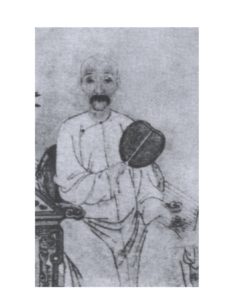
Hong Liangji was a minor governmental official who lived in the Yangzi Valley of China in the 18th and early 19th centuries. He wrote several essays about politics and other subjects. In an essay from 1793 titled “On Governance and Well-being of the Empire” he voiced his view that increasing population would interfere with peaceful rule. Apparently he felt that it was his duty as a Confucian to criticize the emperor. The emperor did not receive this well; he ordered that Hong be decapitated. Fortunately the sentence was reduced to banishment to a minor post.

The background to Hong’s writing was that highly productive new crops allowed China’s population to grow rapidly. This was welcomed by the government, but was recognized by a few as being potentially problematic.

“But in the matter of population, it may be noted that today’s population is… not less than twenty times as large as that one hundred years ago.” Hong wrote. A twenty-fold increase may have been an exaggeration, but his was definitely a time of very rapid population growth.

Hong illustrated his concern with an example. If a family that started with a large home and 3 children on a fair sized farm, at the end of a century they could end up with as many as 100 people (including servants) living in the same house and farming the same area of land. He wrote that the emperor could not stop the people from reproducing, but that harmony could be destroyed by the rapid growth. He observed: “… the resources with which Heaven-and-earth nourish the people are finite.“ He ended this essay on population “The food for one person is inadequate for 10 persons; how could it be adequate for a hundred persons? This is why I am worried about peaceful rule.”

Five years after Hong, Malthus published: “An Essay on the Principle of Population” in 1798. It is no wonder that we usually give Malthus credit for being the first to raise the alarm about population, however, because Hong wrote in Chinese (which few westerners understand), and he ended up in obscurity.

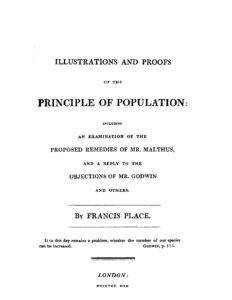
The first person to advocate for family planning was British. In 1823, more than half a century before Sanger was born, Francis Place published pamphlets about family planning for poor women. He taught two methods of birth control, withdrawal and use of a vaginal barrier. Here is a quote he wrote about the latter: “A piece of soft sponge about the size of a small ball attached to a very narrow ribbon and slightly moistened (when convenient) is introduced previous to sexual intercourse and is afterwards withdrawn, and thus by an easy, simple, cleanly and non-indelicate method, in no way injurious to health, not only may much unhappiness and many miseries be prevented, but benefits of an incalculable amount be conferred on society.”

Apparently many rich women knew about “pessaries” to prevent pregnancy, similar to what Place described. However he was the first person to pass this information on to “…the socially less privileged.” One of his pamphlets was named “To the Married of Both Sexes of the Working People and Similarly the Married Sexes in Genteel Life.” The pamphlets were distributed widely throughout England, but the establishment called them “diabolical handbills”.

Place’s personal life is interesting, if perhaps antithetical to his later interest in family planning. He came from a poor family, married at age 19 (his wife was just 17) and they had 15 children! of whom 5 died young. Place educated himself by reading voraciously. He started a successful business that he turned over to his children so he could be politically active. Place’s goal was to improve the lives of the poor. He collaborated with some well-known friends, including Jeremy Bentham and John Stuart Mill.

Large families and rapid population growth affect both society and the individual. Hong wrote about the former; I have not been able to find out much about his personal life. Place was concerned about both later in life. His only book: “Illustrations and Proofs of the Principles of Population” was inspired by Malthus.

© Richard Grossman MD, 2017