Categories
conservation biology Family Planning Greenhouse gases Hope

Offset Your Carbon Impact with PopOffsets


Below, underlined, is the preview of the version of the article that I sent out by email in July.

Gail and I will be sailing across the Atlantic to France–in the stratosphere–the day that this essay appears in the Durango (Colorado) Herald. We love to travel and we have a good reason for this trip. I have wondered for years why conservation biologists don’t pay more attention to human population: after all, if human numbers were smaller, biodiversity wouldn’t be so threatened. It’s kind of like a dentist ignoring candy!
Roger Martin (of the British organization Population Matters) and I will be hosting a roundtable to listen to conservation biologists at the International Congress of Conservation Biologists in Montpellier, France. We want to learn what their attitudes are toward human population, and why they don’t pay the issue more attention. Maybe I’ll have more information about this in another essay!
Thanks for reading.
Richard

PopOffsets picture handing BCPs


We all benefit from using fossil fuels. As a consequence we all cause carbon emissions, and thus contribute to climate change. Is it possible to compensate for our greenhouse gas emissions?

“Yes and no” is the answer. Once CO2 is in the atmosphere it is almost impossible to take it out. Fortunately there are some actions we can take to decrease our impact.

The most important action is to decrease emissions in the first place. In many cases decreasing emissions has the added benefit of also saving money. Thus there are at least two advantages to walking instead of driving, turning off lights you don’t need and—well, you know the litany.

I’m retired and love to travel. How can I make up for the trip to the south of France (largely for business) this summer? Offsets offer a partial solution.

I am writing about voluntary programs where a person voluntarily pays to compensate for his carbon emissions. The PopOffsets website explains this concept well:

“Offsetting is a way of compensating for our residual “footprint”: the level we won’t or cannot reasonably expect to go below. The idea is to pay for projects – which would not otherwise be implemented – which take emissions out of the system to compensate for what we put into it. In other words if an individual or organisation has done what it reasonably can to reduce its emissions (insulation, green energy, efficiency measures, waste reduction, etc), it can compensate for the remainder by investing in projects designed to reduce the amount released to the atmosphere and/or to capture what is being released. Typical projects have traditionally ranged from hydro-electric, solar and wind energy schemes to more efficient cooking stoves to (re)forestation to biofuels to Carbon Capture & Storage (Sequestration).”

There are many different organizations that will help you calculate your carbon emissions, then figure the amount of money that would offset those emissions. One of them is American Forests. Trees absorb CO2 as they grow as well as providing many other benefits. This organization’s website has a carbon calculator to help estimate your carbon footprint, and thus the number of trees that need to be planted to offset that footprint. It also makes it easy to make a donation to so they can plant those trees for you.

Where does human population fit into this? If there are fewer emitters, then there will be fewer emissions. Family planning programs are a good way to slow emissions and thereby slow climate change. Indeed, sophisticated calculations suggest that voluntary family planning programs can make a significant step toward limiting greenhouse gas emissions. A team headed by Brian O’Neill has shown “…that slowing population growth could provide 16–29% of the emissions reductions suggested to be necessary by 2050 to avoid dangerous climate change.”

My column shares its name with an organization in England. The British Population Matters has recognized the advantages of making family planning available to more people. In order to put this noble idea into action they started a unique offset program, PopOffsets. It collects money to support family planning programs. Remember World Vasectomy Day, in which men all over the world get snipped? it received funding from PopOffsets. So has a “backpack nurse” who provides family planning services to people in rural Kenya, and WINGS, a Guatemalan organization that provides reproductive healthcare. PopOffsets has also supported a Population, Health, Environment program in Ethiopia with contraceptive supplies. More surprising is that they also made a grant to an agency close to home—the Utah Population and Environment Coalition.

The goal of PopOffsets is “less carbon, smaller families”. They are apparently unique in the world, and would like to see similar organizations in other countries.

Back to my trip to France. It is roughly 5400 miles from Bayfield to Montpellier, France where my conference will be held. Doubling that for a round trip, we can round up to 11,000 miles, most of which will be flying. The PopOffsets website says that 230 grams of CO2 are emitted for every passenger mile or about 2 ½ tons for this trip. They estimate that $15 spent on family planning will offset one ton of CO2, thus my payment to them should be $37.50. I made a donation for more than that amount knowing that it will support good projects.

For the future of the planet it is important to minimize your carbon footprint. What you cannot get rid of you can offset with PopOffsets!

© Richard Grossman MD, 2015
Categories
Population

Increase Birth Control Pill Access

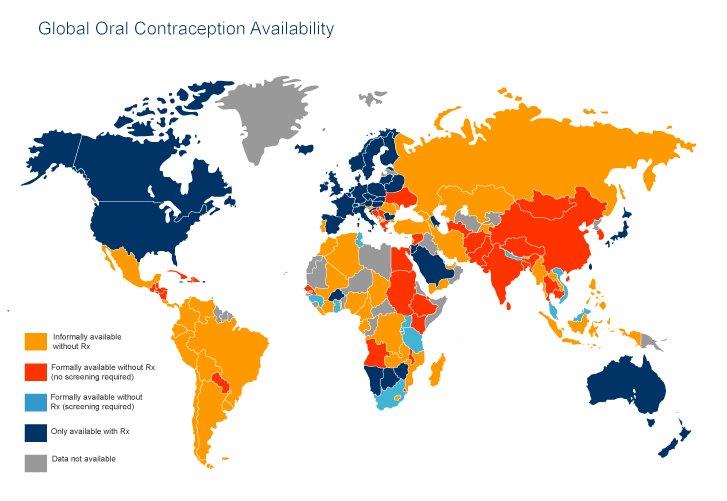
Map of where BCPs available

As the map above shows, birth control pills are available throughout most of the world without a prescription. People in the United States are recognizing that the medicalization of contraception is not necessary, and acts as a barrier to obtaining needed contraception. Go to https://www.facebook.com/freethepill for updated information about the movement to “free the pill”.
The map below is courtesy of Ibis Reproductive Health, and comes from an article in Contraception, “Prescription requirements and over-the-counter access to oral contraceptives: a global review”, 2013.

Should you have to go to a doctor for a prescription in order to buy a medication that is safe, can prolong lives, prevents cancer and helps people feel better?

Although the press often vilifies oral contraceptives whenever a study shows that there is a risk to taking them, the reality is that they are amazingly safe. What is seldom discussed is that they have beneficial side effects. Of course, women react differently and there are many different “pills”, so I cannot promise that every woman will have these benefits.

Acne is a problem for many young women, and one of the best treatments is oral contraceptives (OCs). Likewise, heavy periods, cramps and menstrual irregularity can be eased with these hormones. Because of lighter periods, pill-takers are less prone to anemia. OC users are less likely to develop benign breast cysts, ovarian cancer or cancer of the uterine lining. And, oh yes, if they are taken properly they prevent unwanted pregnancies! Remember, effective contraception has been shown to be the best way to avoid abortion.

A study of over 17,000 women in England taking OCs proved their safety. To quote the conclusion of the study: “Long-term follow-up strongly suggests that OC use slightly reduces all cause mortality.”

What care is essential before starting on OCs? You should know your blood pressure; if it is elevated, you may not be a candidate. You definitely shouldn’t take pills that contain estrogen if you have ever had a stroke or heart attack or a blood clot in your legs. Even if you have a relative who had one of these at an early age you might want to consider another method of contraception. Women who smoke have a greater risk of all these circulatory problems whether or not they take “the pill”. The combination of oral contraceptives and smoking becomes dangerous in women over 35 years of age. Fortunately there are pills without estrogen (progestin only pills) that may be safe for high-risk women.

The upshot is that oral contraceptives are amazingly safe and have health benefits in addition to preventing unplanned pregnancies. Even though there is a slight risk to taking them, the risk to a woman’s life or health of carrying a pregnancy to term is much greater.

Several medications that once required prescriptions have been shown, with experience, to be safe. Ibuprofen (Advil®) and loratadine (Claritin®) are examples. Now there is a push for this transition to happen with birth control pills. The American College of Obstetricians and Gynecologists (the organization that sets the standards for my specialty) came out in favor of over-the-counter (OTC) access to oral contraceptives more than 2 years ago. They recommend that women self-select by using a checklist.

Senator Cory Gardner has introduced a bill to do just that. The major fear is that women with insurance would actually need to pay more for their birth control because currently all insurance policies pay 100%. Unfortunately, most insurance plans don’t pay anything for OTC medications. Another, better Senate bill, introduced by Senator Patty Murray of Washington State, would assure that insurance would continue to pay even if “the pill” went OTC.

For years women have had to go to a provider to get a prescription for “the pill”. This usually involved stripping off clothes and some needless, embarrassing exams. We now recognize that most of this ritual is unnecessary, expensive and acts as a barrier keeping many women from their needed contraception. Women have been able to go to Planned Parenthood and answer a few questions, have her BP checked and leave with her pills. Why shouldn’t a similar program be available at her local pharmacy?

How times have changed! Just 50 years ago the US Supreme Court made contraception legal to all married women. Comstock laws prevented dissemination of birth control literature or supplies before then. Congress passed the first Comstock law in 1873, with the goal of causing “suppression of trade in, and circulation of, obscene literature and articles of immoral use”. Many states passed similar laws. The last of these laws, in Connecticut and Massachusetts, were only struck down in 1965—50 years ago this month.

We are progressing slowly in this country to make safe contraception available to all who want it. Hopefully this will reduce unintended pregnancies—it is sad that now about half of all pregnancies in the USA are unintended. Their financial cost was estimated to be $21 billion in 2010! Much more distressing, however, is the psychological cost of unplanned pregnancies.

© Richard Grossman MD, 2015