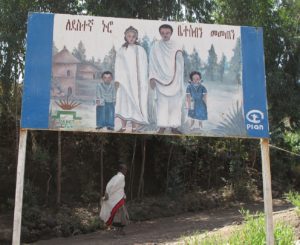
 A sign in Ethiopia showing the positive effects of having only 2 children. (Escape from poverty, health, a better housing, a fertile surrounding with trees, a better education) Picture by Maurice Chédel
“All couples and individuals have the basic right to decide freely and responsibly the number and spacing of their children and to have the information, education and means to do so.†             United Nations, 1994
Although reproductive rights may be in jeopardy in this country, there is reason for optimism both here and abroad.
India has the world’s second largest population—about a billion and a third people. Thanks to family planning programs, family size there has been decreasing slowly through the years. Unfortunately there have been some bad bumps on the road. For instance, decades ago both men and women were sterilized without really understanding their surgery. The government put pressure on family planners to meet quotas and they, in turn, pressured patients to have surgery. Recently several women died after shoddy surgery in tubal ligation “campsâ€. It turned out that these unfortunate women wanted family planning, but weren’t given the option of temporary contraceptive methods nor adequately told of the risks of the surgery.
Sterilization, condoms, “the pill†and IUDs have been the mainstays in India, but the government has just added contraceptive injections to the short list of methods available to women without cost. The “Depo†shot has the advantages of lasting 3 months, of being very effective and lacking the serious side effects of contraceptives with estrogen. Therefore women who cannot use “the pill†can use it. Worldwide, “Depo†has been prescribed for birth control for over 40 years.
Although the USA has some of the most stringent rules for approving medications, I find it interesting that some other countries have limited access to birth control that we take for granted. Depo in India is one example, and birth control pills in Japan are another. For years Japanese women were not able to get “the pill†and couples mainly relied on condoms for contraception. The rationale was that condoms prevented the transmission of disease and could prevent problems if there was marital infidelity. It was only in 1999 that this policy was changed.
In many parts of Africa women needed a physical examination and blood tests before they could get a prescription for “the pillâ€. Few could afford these luxuries, driving up the number of unplanned pregnancies. In much of Latin America, on the other hand, a woman can walk into a “farmacia†and purchase whichever brand she would like.
Emergency contraceptive pills are easily available throughout much of the world. Plan B and other brands are now available in pharmacies in this country without prescription. They have been shown to be amazingly safe, although not as effective as having an IUD inserted. Of course EC should only be used in case of an emergency, such as rape or a broken condom, and it provides no protection against infection.
Price gouging for medications exists outside the USA. In England, for instance, the cost for EC could be more than US$40—while the same medication in France would cost less than US$10. There is an eye-catching British campaign suggesting that a woman in need could save money by taking the bus to Paris to get her pills!
Although millions more women in the USA have access to free family planning thanks to “Obamacareâ€, unfortunately there are still limitations. Some 20 million women in the USA live in “contraceptive desertsâ€. These are areas without reasonable access to publically funded clinics that offer the full range of contraceptive methods. Despite this, the teen-pregnancy rate has fallen precipitously in the past 25 years—a big reason for celebration!
Globally there is mixed news from the immense attempt to provide family planning services in some of the most difficult to reach and poorest parts of the world. The Family Planning 2020 campaign is now about halfway through its tenure, which started in 2012 and goes until 2020. Its goal is to reach 120 additional women with family planning services in 8 years. They have reached 30 million new users of contraception, which is an amazing achievement—but short of their interim goal by 20 million. It is incredibly difficult to deliver health services in areas where this campaign is working; I wish them luck.
Speaking of luck, last month I was hit by a car while crossing Main Avenue in a crosswalk. Fortunately I have no serious injury except for a broken ankle. It is also fortunate that I am totally retired from the practice of medicine—but plan to continue writing these columns. Happy Holidays to readers of Population Matters!
© Richard Grossman, 2016