
Categories
Population

Inspire the United Nations

The Intergovernmental Panel on Climate Change (IPCC) has done wonders by motivating individuals and nations to take action to slow climate change. What could happen if the United Nations formed a similar organization to slow population growth?

I probably don’t need to remind you that far and away the most effective way of slowing climate change is with small families. Indeed, of all the actions that an individual can take, having one fewer child is 14 times more effective than avoiding air travel, being a vegetarian, changing light bulbs and recycling—combined! Fortunately people all over the world are choosing to have fewer children, although I imagine that few are doing this for environmental reasons.

A friend, Rob Harding, has been working tirelessly to form a Framework Convention on Population Growth. The UN states a framework convention: “…describes a type of legally binding treaty which establishes broader commitments for its parties and leaves the setting of specific targets either to subsequent more detailed agreements… or to national legislation.” The IPCC was established by the Framework Convention on Climate Change.

Harding recently attended COP24 (the annual international UN meeting to work on climate change) in Poland in order to witness how the IPCC works and to make contact with UN officials. He has written a description of his proposal for Scientists Warning, available at: https://tinyurl.com/UN-Pop-Proposal.

Harding proposes that the UN take 3 routes to slow population growth. The first is education, which is already well known to have many benefits, including a decrease in family size. Indeed, educating girls and women is one of the most effective means to do this, for several reasons. Educated women are more likely to get married later, to be more independent of their husbands and to use contraception effectively. A further benefit of education is that the offspring of educated parents are more likely to live through childhood. The mother and father will know more about sanitation, will have better incomes and will seek medical care when their kids need it. There is another advantage that might seem paradoxical: parents choose smaller families if they know that their kids will survive to adulthood.

The second effort is to make it easy for people to have access to effective contraception. Harding is careful to specify that there mustn’t be coercion. the 1994 UN’s International Conference on Population and Development turned away from family planning because of the bad experience with coercion in places such as India and China. I feel that it is very important that all family planning programs be voluntary.

I am pleased that Rob decries coercion. The most valid concern that anyone has expressed over his proposal is that the panel might be set up similar to the structure of the IPCC, where each country has a goal to reduce emissions. Goals for the number of people who used contraception (especially sterilization) are blamed for the coercive policies in India and China.

Finally, Harding’s proposal recommends promotion of smaller family size. One of the most remarkable examples of a way to influence family size influence is accidental. In Brazil apparently everyone watches TV, and soap operas are particularly popular. The families in the “soaps” are all small. This is not because the producers want to influence family size choices, but because it is difficult to manage children on a TV set. The average woman had 6 or more children 60 years ago but now the average is less than 2! One of my favorite nonprofit organizations, the Population Media Center, has worked to influence family size choices in many countries using radio and TV shows. Their methodology is very effective, including in Africa where men often want larger families than their wives, according to studies.

Although Harding is employed by a nonprofit organization that is concerned about population, he has been doing this proposal to the UN on his own time. He has already garnered support from several thousand people and about 50 organizations! His hope is to expand the network of people who are interested in the proposal, and perhaps even to find an organization that would take it over as one of its programs.

My impression, when talking with Harding after he returned home from Poland, was that the climate talks were not very productive. I also sensed that he got a dose of the complexity of the United Nations—but he is not discouraged from persisting with his important task of inspiring the UN to recognize and tackle the population problem.

© Richard Grossman MD, 2018
Categories
Contraception Family Planning Hope Public Health

Give Thanks


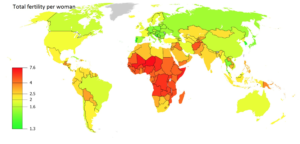
Map of Total Fertility Rates courtesy of M. Tracy Hunter

At the risk of seeming overly optimistic, I would like to make a list of good things that are happening in the world of family planning and demography. Here goes:

My perception is that people are starting to realize the advantages of having small families. Their motivation is two-fold. Many people are realizing that it is possible to be married and have a good life with just one child, or with no children at all. In the USA and in many other rich countries this is practical because we have old age benefits, but more difficult where these benefits don’t exist so people have to rely on their children. There is another, altruistic reason a few are limiting their fertility. They see that the world is already overpopulated and don’t want to contribute further to the problems we are causing.

There are better, safer and more effective contraceptive methods than 52 years ago when Gail and I got married. The number of women using highly effective methods is rising, and (thanks to some good people running altruistic organizations) some are more affordable. An example is Medicines 360 which makes the Lilettaâ„¢ IUD available to nonprofit clinics for just $50.

Colorado was chosen several years ago for a 5 year experiment. Women were able to receive LARCs (Long Acting Reversible Contraceptives, such as IUDs and implants) at no cost, even if they didn’t have insurance. The result was phenomenal—the unplanned pregnancy rate in our state dropped dramatically, and so did the abortion rate. I like to think of all the young people who were able to finish high school and go on to college because of this experiment. That experiment is over, but funding has continued thanks to private and state funding.

Emergency Contraceptive pills are now available without a prescription. This medication is so safe that there are essentially no cases of serious harm from taking it. It is not the best solution, because it is used after a failure—failure of a man to respect a woman, failure of a couple to use contraception or failure of a condom. Nevertheless, EC pills have prevented thousands of unplanned pregnancies.

There is also a movement to make birth control pills available without prescription (www.freethepill.org), or with a prescription from a pharmacist. Now a woman can purchase “the pill” over the internet, and in some states (including Colorado and New Mexico) pharmacists can prescribe hormonal contraceptives by following a protocol. Planned Parenthood has been doing something similar for years. A woman can purchase pills there, if all is ok, after answering a health questionnaire and having her blood pressure checked.

Although the need for abortion is decreasing, there are still all-too-many unplanned pregnancies. Access to abortion services is being curtailed in many parts of this country, causing women to have unsafe abortions. This is similar to what happened before Roe v. Wade in the USA, and is common in countries where abortion is illegal. The good news is that mifepristone and misoprostol, the pills used for a medical abortion, are available over the internet.

There are problems with internet-aided abortions. Most of these pills come from India, are expensive, some are of low quality, and they can take weeks to arrive. Unfortunately, medical care by internet has some inherent issues that will be difficult to resolve. It lacks the personal support that is so important when making an important decision. Also, there are two possible complications. Unless a woman has an ultrasound she might not know that the pregnancy is ectopic. These medications won’t cure a tubal pregnancy, which can rupture and cause serious internal bleeding. And the medications aren’t always effective in ending a pregnancy, so follow-up pregnancy tests are important.

Many countries now have Total Fertility Rates (TFRs) below the replacement rate—the number of children needed to replace the two parents. Replacement rate is slightly more than 2 because some kids die before they reach the age of parenting. This means that the countries’ populations will eventually decrease. Don’t be fooled, however—with few exceptions, all countries have increasing populations due to population momentum and increasing longevity. Of the CIA’s list of countries, only 105 have a TFR above 2.1, and 119 are less. The average TFR for the world is 2.4. We are getting closer to slowing population growth, but still adding about 80 million people to the already overcrowded planet each year.

I’ll be attending the International Conference on Family Planning this month and hopefully will have more good news for you soon!

© Richard Grossman MD, 2018